Meet Atomesus: The Indian AI Platform That Could Be the Most Affordable in the World -- Starting at Just ₹299 a Month
May 08, 2026
India PR Distribution
New Delhi [India], May 8: For most of the past two years, artificial intelligence has dominated headlines, board meetings, and Silicon Valley pitch decks. ChatGPT crossed 100 million users faster than any app in history. Google scrambled to launch Gemini. Microsoft pumped billions into Copilot. And yet, for the average Indian student sitting in a tier-2 city, trying to prepare for a competitive exam or draft a simple business proposal for a family-run shop -- none of these tools really spoke to them. The pricing was in dollars. The interface assumed a level of technical comfort most users simply did not have. The language was overwhelmingly English. The experience felt like it was built for someone in San Francisco, not Surat.
That's exactly the gap that Atomesus is stepping into. And judging by what the platform has managed to pull off in its first sixty days, it's a gap that was very, very hungry to be filled.
One Platform, Built for India
Atomesus describes itself as an India-first AI platform, and that phrase carries more weight than it might first appear. It doesn't just mean the company is headquartered in India or that the founders are Indian. It means the entire product -- the pricing, the language support, the use cases, the distribution strategy -- has been designed from scratch for an Indian user, not retrofitted from a Western template.
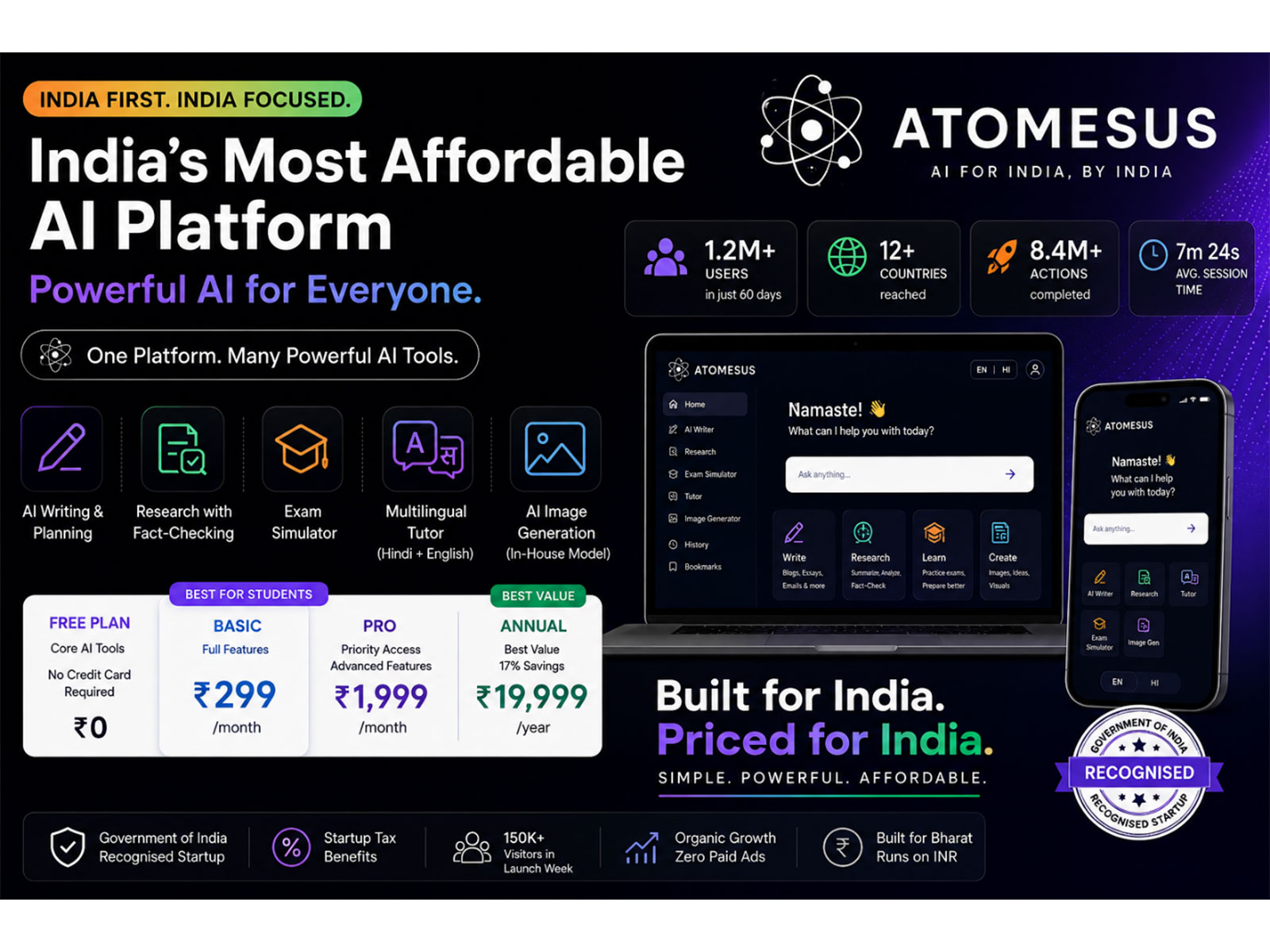
The platform brings together a suite of AI-powered tools under a single roof: AI writing and planning, research summarization with fact-checking, an exam simulator for students, a multilingual tutor tool, and an image generation model that the team says is being built in- house. The interface is a straightforward web product, no technical expertise required.
Users can switch between Hindi and English mid-session. The whole thing is built around the idea that AI should be as easy to use as WhatsApp.
What makes Atomesus genuinely different, though, is the price.
₹299. Not $20.
At a time when most premium AI tools are priced around $20 per month -- that's roughly ₹1,700 at current exchange rates -- Atomesus has launched a full-feature Basic plan at just ₹299 per month. The Pro tier, aimed at professionals and freelancers who need priority processing and advanced features, comes in at ₹1,999 monthly. For power users and small businesses that want to commit annually, there's an Annual plan at ₹19,999 -- saving about 17% versus paying month to month.
There's also a free tier. Not a crippled trial, but an actual free plan that includes core AI tools, requires no credit card, and is designed to function as a viral growth engine -- the idea being that students and first-time users who experience the product for free will eventually convert upward as their needs grow.
This pricing structure is not accidental. It is a deliberate strategic choice built on a simple observation: that the Indian internet economy runs on INR, not dollars, and that any platform wanting to reach India's mass market has to meet users where they are financially, not where Western benchmarks say they should be. Platforms that price in dollars, even with purchasing power parity in mind, create a psychological and practical barrier that quietly keeps hundreds of millions of potential users locked out.
The Numbers That Say Something Real
Traction is everything at an early stage. It's how a platform proves that what it's built isn't just a product but a market. And on that count, Atomesus has a story that is hard to argue with.
In its first 60 days since launch, the platform crossed 1.2 million users. Entirely organically. No paid campaigns. No influencer deals. No aggressive acquisition spend. The platform reached users in 12 or more countries in its very first week. Over 150,000 visitors showed up in that opening week alone. Total actions completed on the platform surpassed 8.4 million. The average session time clocked in at 7 minutes and 24 seconds -- a figure that, in the attention economy, signals that people aren't just landing on the platform and leaving. They're actually using it.
Revenue went live within days of the launch. The company has also secured Government of India recognition and startup tax benefits, meaning the operational cost base is lower than it would be for a comparable foreign competitor trying to serve the same market.
The customer acquisition cost, the company says, is near zero. Growth is being driven entirely by word-of-mouth and product-led mechanics -- the kind of organic flywheel that every startup dreams about but very few actually achieve.
Why the Timing Is Right
India's AI moment is not some future projection. It is happening right now, and the numbers behind it are staggering.
The global AI market is projected to reach $6.1 trillion through 2033, with India growing at a 38% compound annual growth rate -- one of the fastest expansion rates anywhere in the world. PwC and ORF research estimates that AI could unlock $150 billion in value for India's 63 million micro, small, and medium enterprises by 2035. India already accounts for 16% of global AI talent. And yet, as the Atomesus team is fond of pointing out, local- language, affordable AI tools for the average Indian user barely exist.
The servable opportunity in generative AI adoption alone is currently pegged at $22.85 billion globally. The question is who captures the Indian slice of it -- and whether that player will be a foreign platform translating its product for India, or a company that built for India from day one.
Two Reasons This Might Actually Work
There are a lot of India-first tech stories. Many of them have stumbled when the rubber met the road. But Atomesus has articulated two structural advantages that, if executed on, could make this one genuinely defensible.
The first is what the company calls "India-first by design." This is not about adding a Hindi toggle to an English interface. It means building for local pricing realities, genuine linguistic diversity across India's many regional languages, and the actual workflows that Indian students, small business owners, and professionals live and breathe. That kind of depth is hard to replicate quickly from abroad.
The second is distribution. Specifically: students. India has over 250 million students. If you can make a product that students love, that they use daily, that becomes a habit, you have a captive audience that will follow you into professional and business life for decades.
Atomesus is seeding that loyalty now, at scale, through free tools. It's a patient strategy -- and a very powerful one.
The Market Nobody Else Is Playing In
To understand Atomesus's competitive positioning, it helps to look at what it is deliberately not doing.
ChatGPT and Google Gemini are global platforms built for a global, largely English- speaking audience. They are priced in dollars and optimized for enterprise use cases. Microsoft Copilot sits in the same quadrant -- global reach, enterprise focus. Sarvam AI, the most prominent Indian-origin AI company, has taken a different path: it operates at the enterprise and infrastructure layer, with a reported valuation of around $1.5 billion, and targets businesses and developers, not everyday consumers.
Atomesus has positioned itself in the one quadrant that none of these players are seriously competing in: India-first, consumer and MSME focused. The company is explicit about this: it is not competing on revenue per user. It is competing on distribution. Getting to a hundred million users in India is the goal, and the playbook is not a subscription sales funnel -- it is a mass-market adoption play, more similar in spirit to how Jio disrupted Indian telecom than how Salesforce built its business.
The Bigger Picture
There is a larger question sitting behind all of this, one that goes beyond Atomesus specifically. India is at an inflection point with technology adoption. The country that brought the world cheap mobile data through Jio, that built the world's most sophisticated real-time payments infrastructure with UPI, that turned a generation of young people into digital natives -- that country is now absorbing AI at a pace that Western observers may be underestimating.
The next billion users of AI will not look like the first billion. They will speak Hindi, Tamil, Bengali, Telugu. They will earn in rupees. They will use their phones more than laptops. They will need AI that understands their context, their language, and their budget. They will not pay $20 a month. They might very well pay ₹299.
If Atomesus is right about the market -- and the first 1.2 million organic users suggest they are at least asking the right questions -- then the most important AI platform for the next decade might not be the one with the biggest data center or the most parameters. It might be the one that figured out how to make AI useful and affordable for the part of the world that has been waiting, largely overlooked, for someone to build something for them.
That platform, it turns out, starts at ₹299 a month.
Atomesus is currently live at www.atomesus.com.
(ADVERTORIAL DISCLAIMER: The above press release has been provided by India PR Distribution. ANI will not be responsible in any way for the content of the same.)